
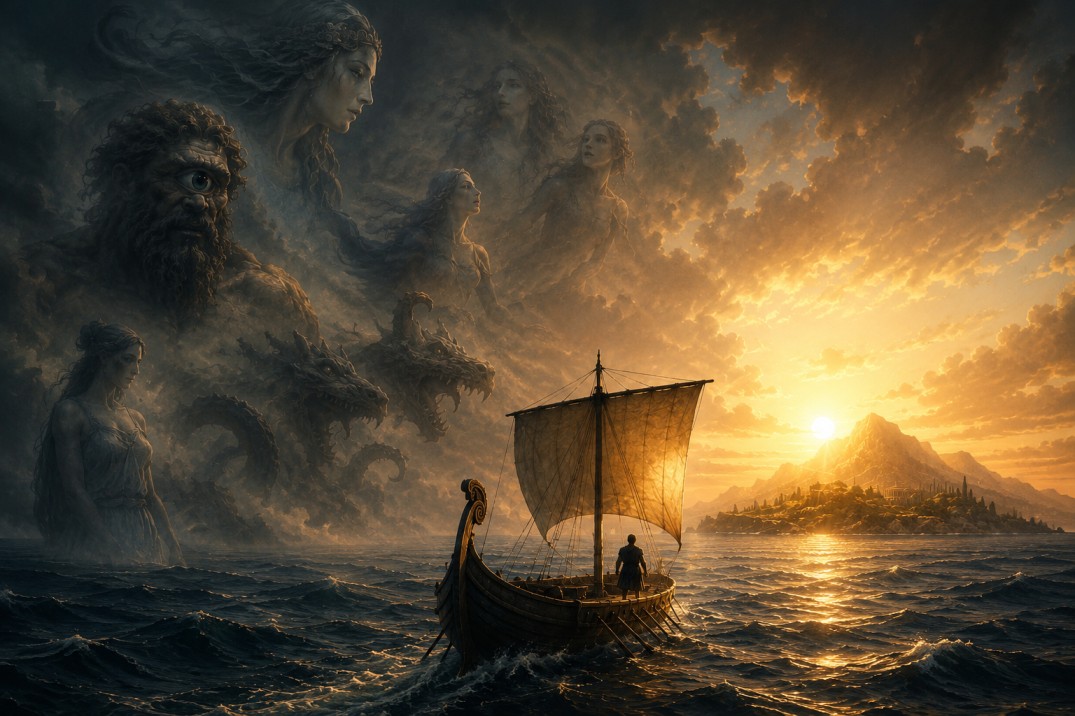
-The Journey Home-
The Journey Begins Long Before the Sea. At first glance, Homer’s Odyssey appears to be an adventure story.
A king fights in Troy, wins the war, and spends ten years trying to return home. But Homer wasn’t interested in geography. He was interested in the human mind.
Every island Odysseus visits represents a temptation. Every monster represents a weakness.
Every victory teaches a lesson. By the time Odysseus reaches Ithaca, the real transformation isn’t that he travelled thousands of miles. It’s that he has slowly learned to master himself.
Because the hardest journey isn’t across oceans. It’s across your own character.
*This article draws primarily from Homer’s original Odyssey. Like many adaptations, recent films condense or omit several episodes to fit the story into a limited runtime.
The Lotus-Eaters – The Danger of Forgetting Your Purpose
This is one of the shortest episodes in the Odyssey, yet perhaps one of the most relevant today.
Some of Odysseus’ men eat the lotus flower. Immediately, they lose all desire to continue the journey home.
Not because they’re imprisoned. Not because they’re hurt.
They simply… don’t care anymore.
That’s terrifying.
Homer’s first obstacle isn’t violence. It’s apathy.
The lotus is anything that slowly disconnects us from our purpose.
- Mindless scrolling.
- Endless entertainment.
- Living only for weekends.
- Working without direction.
- Comfortable routines that require nothing from us.
The danger isn’t that these things are evil. It’s that they make us forget why we started.
Notice what Odysseus does. He doesn’t argue with his men. He physically drags them back to the ship. Sometimes people don’t need better motivation.
They need distance from whatever is numbing them. Escaping the Lotus-Eaters doesn’t mean the journey becomes easier.
If forgetting our purpose is the first danger, the next is losing what we’ve worked so hard to gain.
Aeolus — Opportunity Means Nothing If You Can’t Manage Yourself
The god of winds gives Odysseus a bag containing every dangerous wind. Only one gentle wind remains outside the bag —the one that will carry them safely home.
For days everything goes perfectly. Ithaca is already visible on the horizon.
Then Odysseus falls asleep. His crew assumes the bag contains treasure. Curiosity becomes greed.
They open it.
Every storm escapes.
The ship is blown all the way back across the sea. Think about how painful that is.
They weren’t defeated by enemies. They were defeated when success was already within reach.
How often does this happen?
- Someone builds a successful company- then ruins it through greed.
- Someone loses 20 kilograms- then abandons every healthy habit.
- A couple finally heal- then reopen old wounds because they cannot let the past stay buried.
Sometimes we don’t fail because life is hard.
We fail because success requires discipline after the excitement has faded.
The Cyclops — Intelligence Without Humility Becomes Ego
Odysseus and his men become trapped inside the Cyclops’ cave. The giant begins eating members of the crew. They cannot escape because the enormous stone sealing the cave is too heavy to move.
Odysseus comes up with a brilliant plan.
First, he tells the Cyclops his name is “Nobody.”
Then he gets the Cyclops drunk. Once the giant falls asleep, Odysseus and his men sharpen a wooden stake and drive it into his single eye, blinding him.
The Cyclops screams for help.
Other Cyclopes arrive outside the cave and ask,
“Who is hurting you?”
Polyphemus replies,
“Nobody!”
Hearing that, they assume he’s not actually being attacked and leave.
It’s one of the cleverest moments in all of literature.
Odysseus wins.
The men escape by hiding beneath the Cyclops’ sheep as they leave the cave. The danger is over. The story should end there.
But then…
Odysseus cannot resist.
As the ship sails away, he shouts back at the Cyclops.
At first, he mocks him. Then he has the audacity to reveal his real name. He says-
“Cyclops—if any man on the face of the earth should ask you who blinded you, shamed you so—say Odysseus, raider of cities, he gouged out your eye, Laertes’ son who makes his home in Ithaca!”
Why?
Because victory wasn’t enough. His ego wanted recognition.
That single sentence changes everything.
Polyphemus is the son of Poseidon. Once he knows who attacked him, he prays to his father.
Poseidon answers. The sea turns against Odysseus. Years of storms, suffering, and wandering follow. It’s one of the greatest examples in literature of a self-inflicted wound.
Odysseus wasn’t defeated by the Cyclops.
He was defeated by the part of himself that couldn’t leave quietly.
How many careers have been damaged because someone had to prove they were right?
How many relationships ended because someone needed the last word?
How many opportunities disappeared because pride refused to apologise?
Sometimes our biggest mistake isn’t making a bad decision.
It’s announcing our victory.
There is a quiet confidence that achieves something and moves on. And there is ego, which needs an audience. The first brings peace. The second often invites unnecessary battles.
Odysseus escaped the cave because of his intelligence. He extended his suffering because of his pride. One strength saved him. Another strength taken too far -became his weakness.
Even our virtues become dangerous without moderation.
Pride isn’t the only force capable of leading us astray. Sometimes we aren’t undone by arrogance, but by something far quieter—our inability to master our own desires.
Circe – When Pleasure Makes Us Forget Who We Are
Circe is often remembered as the Witch who turned Odysseus’ men into pigs.
But Homer wasn’t writing about magic. He was writing about what happens when appetite replaces judgment.
He could have transformed them into lions- symbols of strength or eagles – symbols of nobility.
Instead, he chose pigs. It wasn’t an accident.
The transformation wasn’t really about their bodies. It was about their character. Think about how often we willingly become prisoners of our own appetites.
- We binge one more episode when we promised we’d sleep.
- We buy things we don’t need to impress people we don’t know.
- We reach for another distraction because silence forces us to confront ourselves.
None of these choices make us less intelligent overnight. But little by little, they can make us less free.
Homer suggests that we don’t lose our humanity all at once. We surrender it gradually, each time we allow pleasure to outrank purpose, appetite to silence reason, or convenience to replace discipline.
In that sense, Circe’s magic isn’t confined to mythology. It exists wherever we allow our impulses to decide who we become.
The Sirens — The Trap You Don’t See
The Sirens are fascinating because they never force anyone to do anything.
- They don’t attack.
- They don’t threaten.
- They don’t even leave their island.
They simply sing. The sailors destroy themselves.
That’s why the Sirens remain one of literature’s greatest metaphors. The most dangerous traps in life don’t look dangerous. They look like exactly what we’ve always wanted.
Imagine someone saying,
“Take this shortcut. You’ll be successful without the years of work.”
Or,
“One more hour scrolling won’t hurt.”
Or,
“Just prove them wrong.”
Or,
“Text your ex one last time.”
None of these feel-like disasters- they feel reasonable. That’s exactly how Sirens work.
What is your Siren song?
If the Sirens existed today, they wouldn’t sing from rocks in the sea.
- They’d whisper through your phone
- They’d sound like notifications
- Comparison
- Validation
The need to constantly check whether people approve of you. The endless pursuit of “just a little more.” Because temptation rarely announces itself as temptation.
It introduces itself as opportunity.
And sometimes Sirens don’t tempt us with the future. They tempt us with the past. They whisper- “You can get back what you’ve lost.”
- The relationship.
- The version of yourself from college.
- The friendship.
- The company before it failed.
- The childhood home.
- The parent who’s gone.
The life that existed before one mistake changed everything.
Odysseus longed to return to Ithaca.
But even if he made it home, twenty years had passed.
- His son had become a man.
- His kingdom had changed.
- Even he had changed.
The Sirens represent one of life’s hardest truths:
You can go home.
You just can’t go back.
That’s a lesson many of us spend years resisting.
We replay old conversations.
We imagine different endings.
- We wish we had chosen another career.
- Another city.
- Another relationship.
We become emotionally anchored to a version of life that no longer exists.
Meanwhile, our actual life keeps sailing forward without us. Sometimes healing begins when we stop asking,
“How do I get my old life back?”
and start asking,
“Given who I am today, what life can I still build?”
The Sirens don’t promise destruction.
They promise understanding.
They say, “Come here… no one has ever sailed past us without learning something.”
How modern is that?
Today we’re surrounded by voices claiming to have the secret.
- The perfect investment.
- The perfect productivity system.
- The perfect relationship advice.
- The perfect body.
- The perfect life.
Every algorithm says,
“Click here. This will finally make sense.”
The danger isn’t information.
It’s believing every voice deserves our attention.
Wisdom isn’t hearing everything. It’s knowing what not to listen to.
Scylla and Charybdis — Sometimes Every Choice Hurts
This may be Homer’s most mature lesson.
Odysseus must sail through a narrow strait. On one side waits Charybdis, a whirlpool capable of swallowing the entire ship. On the other waits Scylla, a monster that will seize six sailors.
There is no third option. No perfect solution- No clever trick- No heroic victory.
He must choose the smaller loss.
That’s adulthood.
As children we believe every problem has a correct answer.
Adults eventually realise that many decisions involve choosing between two imperfect outcomes.
- Stay in the stable job or risk starting the business.
- Move abroad or stay close to family.
- Tell a painful truth or protect someone’s feelings.
- End the relationship or remain unhappy.
Leadership often isn’t choosing between good and bad. It’s choosing between bad and worse.
One of the greatest signs of maturity is accepting that not every decision feels fair.
The Cattle of Helios — Small Acts of Indiscipline Have Huge Consequences
Odysseus repeatedly warns his crew not to touch the sacred cattle of Helios, no matter how desperate their hunger becomes. He knows that some boundaries, once crossed, carry consequences far greater than they seem.
But hunger has a way of changing our judgment.
Days pass. Their supplies run out. Exhaustion clouds their minds, and what once felt unthinkable slowly begins to sound reasonable. They convince themselves that breaking the rule just this once couldn’t possibly matter.
It does.
The destruction that follows isn’t caused by a great battle or an impossible storm. It begins with a single compromise.
Perhaps that’s Homer’s point.
Our lives are rarely undone by one catastrophic decision. More often, they’re shaped—and sometimes unravelled by the small exceptions we allow ourselves to make.
- “I’ll skip today’s workout.”
- “I’ll start saving next month.”
- “It’s only one unnecessary purchase.”
- “One more drink won’t hurt.”
- “I’ll apologize tomorrow.”
Each choice seems too insignificant to matter. Yet character is built—or eroded—not in extraordinary moments, but in the quiet decisions we make every day.
Discipline isn’t tested when doing the right thing is easy. It’s tested when every excuse feels justified.
If Helios reminds us that discipline shapes character, Athena reminds us where that discipline comes from—not force, but wisdom.
Athena — Wisdom Doesn’t Fight for You
One of the most common misconceptions about the Odyssey is that Athena simply rescues Odysseus whenever he is in trouble. She doesn’t.
She guides him, offers counsel, creates opportunities, and occasionally intervenes, but she never completes the journey on his behalf. Every crucial decision still belongs to Odysseus. He must choose the harder path, endure the consequences of his mistakes, and find the courage to keep rowing.
That distinction is important because it’s how wisdom works in our own lives.
Wisdom can illuminate the path, but it cannot walk it for us.
We can read countless self-help books, listen to inspiring podcasts, seek advice from mentors, learn from our parents’ experiences or work through our fears in therapy. Each of these can point us in the right direction, but none of them can make the difficult choices on our behalf.
There comes a moment when every person must pick up the oars and steer their own ship.
Perhaps that’s why Athena never overshadows Odysseus. She represents the quiet voice of wisdom that is always available to us, but never forces itself upon us. Unlike the Sirens, who lure us with promises and demand our attention, wisdom rarely shouts. It whispers.
The tragedy is that we often find it easier to listen to the voices that flatter our desires than to the one that quietly asks us to do what is right.
The Sirens sing loudly because temptation competes for our attention.
Wisdom rarely needs to compete. It simply waits for us to become ‘quiet’ enough to hear it.
Calypso — When Comfort Becomes a Prison
Most people assume the greatest obstacles are painful. Homer suggests something far more dangerous: Comfort.
After surviving storms, monsters, cannibals, and death, Odysseus reaches Calypso’s island.
She offers him everything.
- Safety
- Luxury
- Love
- No responsibilities.
- No uncertainty.
- No hardship.
- She even offers him immortality.
Who would leave?
Odysseus stays.
Not for seven days or seven months. But for seven years.
Think about that.
- The Cyclops couldn’t stop him.
- Poseidon’s storms couldn’t stop him.
- Scylla couldn’t stop him.
- Shipwrecks couldn’t stop him.
Comfort did.
That’s incredibly relevant today. People often imagine failure as losing. But many dreams die because life becomes comfortable enough.
- You stop learning because your job pays well enough.
- You stop taking risks because your routine is predictable.
- You stop building the business because the salary is “good enough.”
- You stop writing because Netflix is easier.
Comfort isn’t evil. It’s simply dangerous when it quietly replaces purpose.
Calypso’s island wasn’t a prison because she locked the gates. It was a prison because leaving meant choosing uncertainty. Growth almost always asks us to leave islands that feel safe.
Most prisons have bars. Calypso’s prison had cushions. And perhaps those are the hardest prisons to leave.
Penelope — The Quiet Strength We Often Ignore
Most heroes are remembered for battles.
Penelope wins without fighting.
For twenty years she remains faithful while surrounded by men demanding she choose a new husband. She survives not through force.
- But patience.
- Intelligence
- Emotional endurance.
Every night she secretly unravels the cloth she wove during the day, delaying her decision.
She teaches something modern culture often overlooks.
- Not every victory requires movement.
- Sometimes endurance is courage.
- Sometimes waiting is wisdom.
It’s easy to admire courage on a battlefield because it is loud and visible. Penelope reminds us that another kind of courage exists—the quiet courage of remaining faithful to one’s values when no one is applauding. Her battle isn’t fought with swords, but with patience, resilience, and the quiet refusal to compromise.
Sometimes refusing to compromise is the bravest action available.
Patience isn’t the absence of action. Sometimes it is the highest form of action.
Ithaca — The Destination Was Never the Point
Here’s the beautiful irony.
Odysseus spends twenty years trying to return home (including the 10 years of fighting the Trojan war).
When he finally arrives…
nothing is the same.
His son has grown up.
His palace is occupied.
His wife has suffered.
Even Odysseus must disguise himself because the man who left Troy no longer exists.
This is perhaps Homer’s greatest lesson.
We spend much of our lives believing happiness lies just beyond the next destination.
“I’ll be happy when…”
- I graduate.
- I get promoted.
- I get married.
- I buy the house.
- I retire.
Then we arrive and realise the destination changed us.
Ithaca wasn’t valuable because it remained unchanged. It was valuable because the journey transformed the person who returned.
As the Greek poet Constantine Cavafy would write nearly three millennia later:
“Hope your road is a long one.”
Because journeys are never about arriving.
They’re about becoming.
Closing Thought — We Are All Sailing Home
By the end of the Odyssey, Odysseus is no longer fighting creatures from myth. He is confronting temptation, comfort, grief, pride, impossible choices, and ultimately, the disorder that has taken root in his own home during his absence.
The final battle isn’t really against the suitors. It is against everything that accumulated while he was away—chaos replacing order, arrogance replacing humility, excess replacing justice.
We all have Sirens—the voices that promise fulfilment while quietly leading us off course.
We all have Lotus Islands—the habits that make us forget what matters.
We all meet Calypso—the comfort that asks us to stop growing.
We all face Scylla and Charybdis—the impossible choices where every option costs something.
We all carry a Cyclops within us—not the monster itself, but the ego that wants recognition after victory.
And somewhere, beyond all of that, lies our own Ithaca. Not as a place waiting for us, but as the person we become if we keep sailing.
Perhaps that’s why the Odyssey has endured for nearly three thousand years.
It begins as a story of survival. But somewhere along the journey, Homer quietly shifts the story from survival to self-mastery. The monsters become less important, and the lessons become more internal.
Perhaps that’s Homer’s greatest insight:
Every long journey begins by overcoming the world around us. Every meaningful journey ends by overcoming ourselves.
Let us know your thoughts Reach out to Dee-Cognito