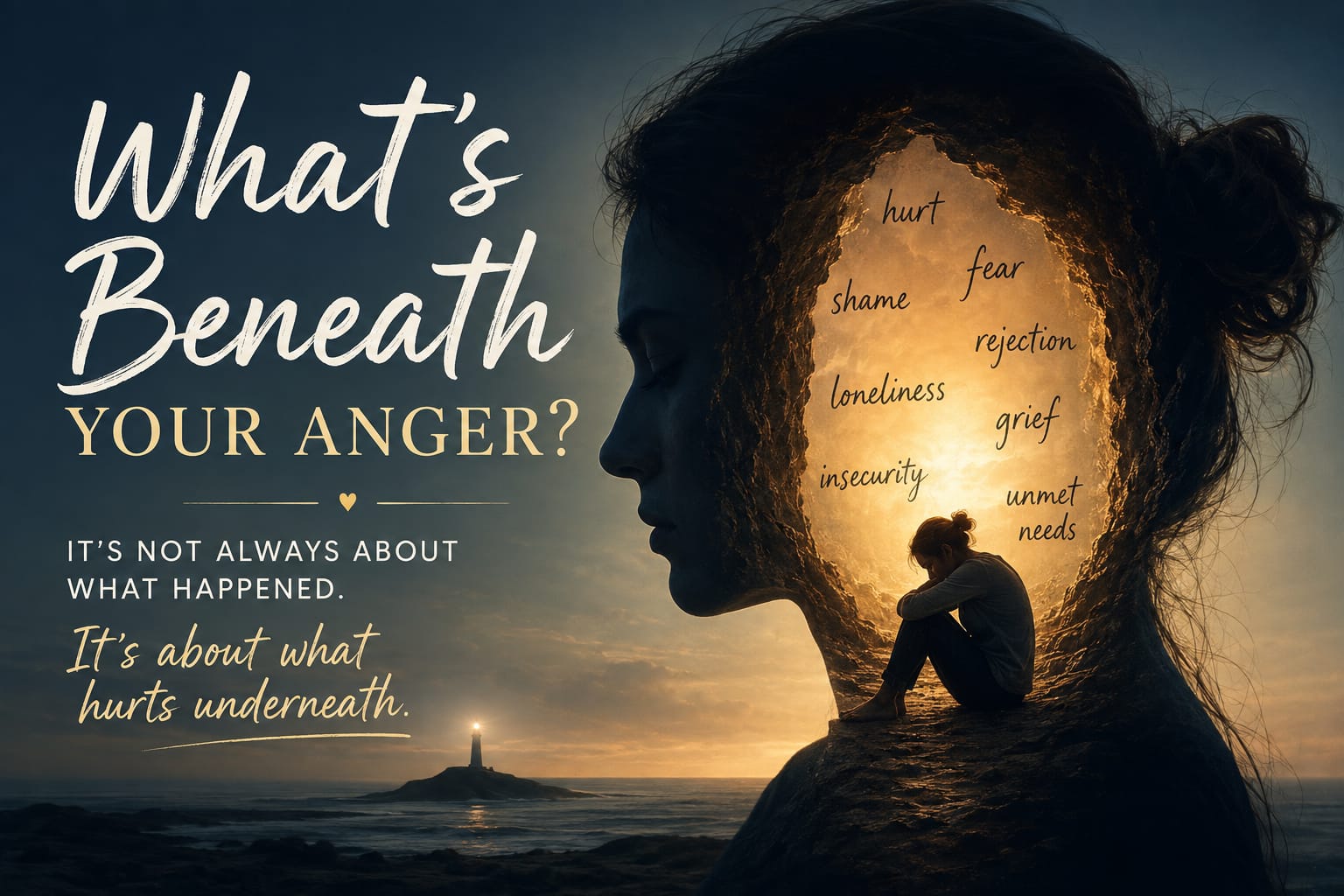
“The opposite of anger isn’t calm. It’s honesty.”
Anger has a way of convincing us that it is the whole story.
It arrives suddenly. It raises its voice. It demands justice. It wants to explain, defend, accuse, protect or walk away. It feels powerful, certain and urgent.
But what if anger is not the story?
What if it is only the narrator?
What if the real story is happening somewhere beneath it—quietly waiting to be heard?
We often think of anger as an emotion that needs to be controlled. We talk about anger management, anger issues and angry personalities. Rarely do we stop to ask a different question:
What is your anger trying so hard to protect?
This question changes the way we understand not just anger, but people.
What If Anger Isn’t the Real Emotion?
Anger is often the bodyguard, not the king.
Imagine a bodyguard standing outside an important room.
He looks intimidating. He raises his voice. He pushes people away. He doesn’t let anyone enter.
If you only saw him, you might assume he was the most important person in the building.
He’s protecting someone inside.
Our anger often functions in exactly the same way.
It is loud because the emotions it protects are fragile.
Behind anger, we often find heartbreak.
- Fear
- Shame
- Loneliness
- Grief
- Helplessness
Or simply the longing to be loved, understood and accepted.
The tragedy is that most of us spend our lives arguing with the bodyguard without ever meeting the person he is trying to protect.
Why Anger Feels Safer Than Vulnerability
Anger isn’t always what you’re feeling, sometimes it’s what you’ve learned you’re allowed to feel.
How many of us heard things like:
- “Stop crying.”
- “Don’t be so sensitive.”
- “Be strong.”
- “You’re overreacting.”
- “Big boys don’t cry.”
- “Good girls don’t make a scene.”
Very few of us were taught how to sit with disappointment or how to express fear without shame or even how to admit that we felt rejected. We aren’t just taught how to behave. We are taught which emotions deserve to exist.
Some emotions receive comfort while others receive correction.
As children, we slowly begin to sort our emotional world into two invisible categories:
Acceptable Emotions and Unacceptable Emotions
If we cry, we’re told to stop.
If we’re afraid, we’re told to be brave.
If we feel lonely, we’re told to keep ourselves busy.
If we need reassurance, we’re told not to be so dependent.
Anger often receives a quick attention.
- It gets people to listen.
- It protects our dignity.
- It makes us appear strong even when we feel fragile.
Over time, the psyche doesn’t stop experiencing sadness, fear or shame. It simply learns to hide them behind an emotion that feels safer to express. Anger isn’t always the emotion we’re truly feeling. Sometimes, it’s the emotion we’ve learned we’re allowed to show.
The Emotions Hiding Beneath Anger
Not all emotions receive the same welcome. Some emotions are accepted while others are rejected.
And the rejected emotions don’t disappear. They simply change the way they appear on the surface.
Sadness becomes irritation.
Helplessness becomes control.
Vulnerability becomes anger.
Because anger feels safer.
Anger doesn’t expose us. It protects us.
Psychology sometimes describes this as defensive affect—when one emotion steps forward to shield us from another that feels too painful, too threatening or too vulnerable to experience directly. Anger often plays that role.
- It doesn’t erase grief.
- It doesn’t eliminate fear.
- It doesn’t heal shame.
- It simply stands in front of them, saying,
“I’ll take it from here.”
Seen this way, Anger isn’t deceiving us. It’s trying to protect us. It is protecting something we don’t yet feel safe enough to face.
Society often applauds strength. This emotional rulebook isn’t written only by our families.
It’s reinforced by schools, workplaces, cultures, faith communities, media and even our friendships.
Many boys grow up hearing,
Many girls grow up learning,
Yet the outcome is often the same.
People begin hiding parts of themselves because those emotions don’t seem welcome.
Every society has emotional norms.
They quietly teach us which feelings make us acceptable and which ones should remain unseen.
Perhaps this is why vulnerability feels so frightening. It isn’t because we’re incapable of it. It’s because we’ve spent years learning that acceptance often depends on hiding it.
And so, society often applauds strength while remaining deeply uncomfortable with vulnerability.
We often admire the person who stands their ground, who speaks their mind loudly, and who refuses to tolerate disrespect –They appear emotionally unshakable.
- “I’m scared.”
- “I’m hurt.”
- “I need help.”
- “I feel abandoned.”
is often met with discomfort.
We don’t always know what to do with vulnerability.
So, we unintentionally reward anger more than honesty.
Which sentence feels easier to say?
The second sentence requires courage.
Because it hands someone the truth instead of the weapon.
Why does society accept anger more than tears?
Every angry reaction has a history. Sometimes we believe our anger is about today’s incident.
But today’s incident is simply touching yesterday’s wound.
Someone ignores your message.
Was it really about the message? Or did it awaken an old fear that says, “People leave.”
A partner criticizes you and you react defensively. Was it really about the criticism? Or did it awaken the belief- “I’m never good enough.”
Someone excludes you from a conversation and you notice you’re feeling unusually angry.
Perhaps beneath that anger lives a child who remembers never feeling chosen.
Children don’t learn what emotions are. They learn which emotions preserve connection.
- “When I cry, people become uncomfortable.”
- “When I say I’m scared, I’m told to stop worrying.”
- “When I’m angry, people finally pay attention.”
No child consciously decides to become an angry adult.
- “This emotion keeps me safe.”
- “This emotion keeps me connected.”
Years later, that lesson continues to speak through our reactions—even when the people around us are no longer the ones who taught it.
When Today’s Anger Belongs to Yesterday’s Wounds
The present often borrows its emotional intensity from the past. Which is why anger can sometimes feel disproportionately large. It isn’t reacting only to this moment.
It is reacting to every similar moment that came before it.
Sometimes anger protects an identity- We often say anger hides another emotion.
Well, it goes even deeper. Sometimes anger protects the way we see ourselves.
Imagine someone questions your competence.
The anger may not be protecting your pride. It may be protecting a deeply rooted belief that your worth depends on always being capable.
The anger may not simply be covering sadness.
It may be protecting the identity that says,
“If people don’t choose me, maybe I’m not lovable.”
Someone betrays your trust.
The anger may be guarding something even deeper:
“The world is no longer safe.”
If we keep asking what lies beneath anger, we eventually arrive at something surprisingly tender.
The quiet conclusions we formed long before we had the words to explain them.
The Language of Anger in Relationships
Our relationships often suffer because we speak in the language of anger instead of the language of need.
Listen carefully to arguments.
- “I don’t care.”
- “You always do this.”
- “Just leave me alone.”
- “I’m done.”
Sometimes those words are translations.
What they actually mean is:
- “Please don’t abandon me.”
- “Please hear me.”
- “Please make me feel important.”
- “Please tell me I matter.”
Unfortunately, anger is a poor translator.
It often hides the very message that most needs to be heard. The more frightened we become, the louder our anger speaks.
And the louder our anger speaks, the harder it becomes for others to hear the vulnerability underneath.
Relationships begin to heal not when anger disappears… but when honesty becomes safer than defence.
Your Defences Are Not The Enemies
Every defence once had a purpose. Psychology often speaks about defence mechanisms.
The term can sound clinical. But perhaps we should think of them differently.
Every defence was once an act of survival.
- If crying brought ridicule…anger became protection.
- If expressing fear invited criticism…confidence became a mask.
- If asking for comfort led to rejection…self-sufficiency became an identity.
We don’t develop these patterns because something is wrong with us. We develop them because, at some point, they worked.
The problem is not that we built emotional armour. The problem is forgetting that we’re still wearing it long after the battle has ended.
Questions to Ask When Anger Takes Over
The next time you notice anger rising, resist the urge to judge it immediately.
What happened just before I became angry?
What am I afraid of losing?
What expectation was broken?
What need isn’t being met?
What am I trying so hard to protect?
If I wasn’t allowed to say “I’m angry,” what emotion would I name instead?
You may discover that your anger has been carrying a burden that was never really its own.
If Your Anger Could Speak, What Would It Whisper?
Perhaps anger has been misunderstood for ages. We often treat anger like an enemy.
- Something to suppress.
- Something to conquer.
- Something to eliminate.
But perhaps anger is less like an enemy and more like a messenger knocking on a locked door.
The mistake isn’t that anger arrives. The mistake is ending the conversation there.
Because anger is rarely the final destination, it’s an invitation. An invitation to meet the frightened child who still longs to be chosen.
- The grieving heart that never had permission to mourn.
- The exhausted soul that has carried too much for too long.
- The lonely person who only wanted to belong.
- The vulnerable self that has spent years hiding behind strength.
Perhaps beneath every loud expression is a quiet whisper asking,
“Can someone please see what I’m really feeling?”
Maybe that someone has to be us first.
Because healing doesn’t begin when we silence our anger.
Healing begins when we finally become curious enough to ask,
“If my anger could speak without shouting… what would it whisper?”
Perhaps the question was never,
“How do I get rid of my anger?” Perhaps the better question is,
“What has my anger been protecting all along?”
Because anger is rarely the final destination.
And if we have the courage to walk through it instead of fighting it, we often discover not rage, but grief. Not hostility, but fear. Not aggression, but longing.
And if we have the courage to walk through it instead of fighting it, we often discover not rage, but grief. Not hostility, but fear. Not aggression, but longing.
The loudest emotion in the room is rarely the deepest one.
Healing begins the moment we become curious enough to listen beneath the noise.
Perhaps, beneath your anger, there isn’t an enemy waiting to be defeated.
Perhaps there’s simply a part of you that has been waiting, for years, to be understood.
If this article resonated with you and you find yourself feeling trapped beneath your anger, you don’t have to navigate it alone.
Reach out to Dee-Cognito and begin understanding what your anger has been trying to protect all along.