
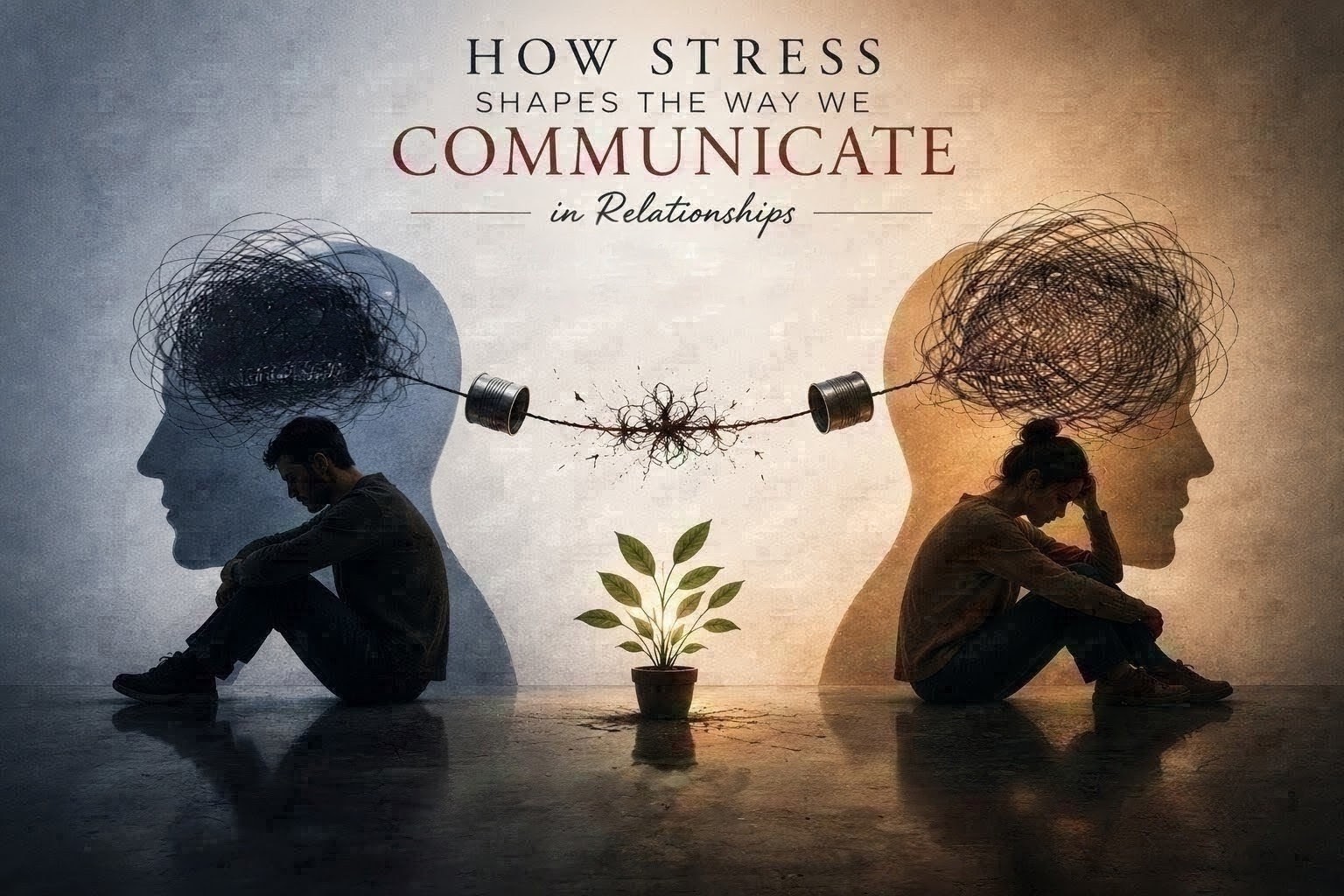
What happens to your communication when you’re stressed?
- You might become louder.
- You might disappear.
- You might go completely blank.
- You might shut down.
- Or you might say, “It’s okay, whatever you want,” when it is very much not okay.
And later, when you’re calm, you might wonder:
Why did I react like that?
Here’s something worth considering:
Maybe it wasn’t just your personality speaking. Maybe your nervous system was.
When the brain senses threat, it shifts into protection mode. The threat doesn’t have to be physical. It can be conflict, rejection, criticism, abandonment, feeling powerless, or simply becoming emotionally overwhelmed.
And when we don’t feel safe, communication can change dramatically.
The Four Common Stress Responses
Fight. Flight. Freeze. Fawn.
You may recognise yourself in one—or move between several.
Fight: “I need to take control.”
- You get angry.
- You push.
- You correct.
- You argue.
- You demand answers.
- You need things done your way.
Fight isn’t always obvious aggression. It can also show up as criticism, perfectionism, controlling behaviour, or needing the last word.
Underneath it may be:
“If I can control what happens, I can feel safe.”
The problem is that what feels like protection to you can feel threatening to someone else.
The harder you push for control, the less safe the other person may feel around you.
Flight: “Let’s just not go there.”
Some people don’t fight.
They leave.
Not necessarily the relationship—the conversation.
They bury themselves in work.
Fill every hour of the day:
- Scroll.
- Exercise.
- Clean.
- Stay constantly busy.
Anything that keeps them from sitting with the uncomfortable feeling.
So instead of saying:
“That conversation hurt me.”
it becomes:
“I’m just really busy right now.”
Flight can look like independence.
Sometimes it is.
Sometimes it’s avoidance wearing a very convincing disguise.
Freeze: “I don’t know what to say.”
You’re asked a question.
- Your mind goes blank.
- You shut down
- You know you have feelings, but you can’t access the words. You can’t decide. You can’t respond.
From the outside, it can look like silence or indifference.
Inside, it can feel like:
“I genuinely cannot process this right now.”
Freeze can be a temporary pause while your brain tries to work out what is happening.
For some people, especially when trauma is involved, it can become a deeper shutdown—numbness, disconnection, brain fog, or feeling detached from the moment.
So going blank isn’t always avoidance.
Sometimes your nervous system has simply reached its processing limit.
Fawn: “If I keep you happy, maybe everything will be okay.”
This one can be harder to recognise because it can look like kindness.
- You apologise quickly.
- You say yes when you mean no.
- You change your opinion.
- You absorb someone else’s anger.
- You become very good at knowing what everyone else needs—and strangely disconnected from what you need.
It sounds like:
- “I don’t mind.”
- “Whatever you want.”
- “It’s fine.”
- “Sorry, I didn’t mean to upset you.”
Even when you’re the one who was hurt.
At some point, keeping the peace can become more familiar than telling the truth.
- You may not even call it people-pleasing.
- You might simply think.
- I’m just not a confrontational person.
When Two Nervous Systems Meet
This is where relationships get interesting.
- One person feels threatened and wants to talk about it now.
- The other feels threatened and wants to get away from it.
- One moves closer and the other moves further away.
- Now one is thinking:“Why are you abandoning me? And the other “Why won’t you give me space?”
The argument may look like it’s about communication.
But underneath it, two nervous systems may simply be responding to what feels unsafe.
And that’s why the same argument can happen again and again.
The topic changes.The pattern doesn’t.
So What Are You Actually Responding To?
The next time you notice yourself reacting strongly, ask:
- What am I afraid will happen if I don’t react this way?
- If I don’t take control, will everything fall apart?
- If I speak honestly, will they reject me?
- If I say no, will they be angry?
- If I stay in this conversation, will I become overwhelmed?
- If I stop keeping everyone happy, will they leave?
These questions take you somewhere deeper than:
“Why am I like this?”
Because your reaction may have made sense once.
It may have protected you.
But a strategy that once helped you feel safe can eventually become a pattern that keeps you stuck.
Before You,Your Nervous System Speaks for You
Understanding your stress response isn’t about excusing your behaviour.
It’s about noticing the pattern underneath it.
Maybe the first step isn’t:
“I need to communicate better.”
Maybe it’s simply noticing:
- I’m getting defensive.
- I’m about to disappear.
- I’m going blank.
- I’m agreeing, but I don’t actually agree.
That tiny moment of awareness matters.
Because between the trigger and the reaction, there can be a pause.
And inside that pause is something powerful choice.
Not the choice to never get angry, scared, overwhelmed, or shut down.
But the choice to slowly learn:
What does safety look like for me—and how can I communicate from there?
Maybe healthier communication doesn’t begin with finding the perfect words.
Maybe it begins much earlier.
Want to handle stress better?
Reach out to Dee-Cognito